Summer can place more pedestrians and vehicles on Colorado Springs roads at the same time. Residents and visitors walk near parks, restaurants, shops, hotels, trails, tourist destinations, and community events. Longer activity hours, sun glare, construction, sudden storms, distracted driving, turning vehicles, crowded parking areas, and unfamiliar motorists can create added risks.
Summer is not necessarily the deadliest season for pedestrians in Colorado. State data show that darkness and low-light conditions are major factors in fatal pedestrian crashes. The more accurate concern is that summer activity can increase pedestrian exposure and create specific hazards that may contribute to a collision.
If you are injured while walking, the facts of the crash will matter. A complete investigation may examine driver behavior, traffic signals, road design, vehicle speed, visibility, witness statements, nearby video, weather, and your actions before impact. The Law Firm of Mark S. Hanchey and Ben Peterson helps injured pedestrians understand how fault, insurance coverage, medical records, and Colorado personal injury law may affect a claim.





Why Summer Creates More Pedestrian Exposure 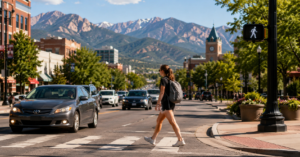
Colorado Springs residents often spend more time outside during summer. Families visit parks, people walk to restaurants and shops, tourists explore local attractions, and students may have more time outdoors while school is not in session.
Summer also brings outdoor gatherings, sporting events, festivals, neighborhood activities, and heavier use of trails and recreation areas. These activities place more people near:
- Intersections and crosswalks
• Parking-lot entrances and exits
• Driveways
• Commercial entrances
• Event drop-off areas
• Roads near parks and trails
• Downtown streets
• Hotel and tourist areas
More pedestrian activity does not mean that people are acting carelessly. It means that drivers and pedestrians may encounter one another more often.
Longer Activity Hours Can Increase Roadway Exposure
Long summer days encourage people to walk earlier in the morning and later in the evening. You may take an evening walk, meet friends downtown, attend an outdoor event, or walk between a parking area and a restaurant after work.
Daylight can improve visibility, but it can also extend the hours when pedestrian activity remains high. Drivers may be tired after a full day, distracted by passengers, or focused on finding parking or an address.
Late-afternoon sun can create strong glare. A driver traveling toward the sun may have difficulty seeing a person in a crosswalk, a traffic signal, or a stop sign. Glare does not excuse unsafe driving. A motorist must reduce speed and maintain attention when visibility is limited.
When you need legal help, Mark Hanchey and Ben Peterson are here to guide you through it all. One step at a time. Reach out today for legal support. Get The Law Firm of Mark S. Hanchey and Ben Peterson fighting for you.
With You Every Step of the Journey
Tourism Brings More Drivers Who Are Unfamiliar With Local Roads
Colorado Springs attracts visitors during summer. Some drivers may be unfamiliar with local intersections, speed limits, lane patterns, pedestrian-heavy areas, or parking entrances.
A visitor may focus on a navigation application, search for a destination, slow suddenly, change lanes late, or turn after missing a street. These actions can place pedestrians at risk, especially near:
- Hotels
• Restaurants
• Tourist attractions
• Shopping areas
• Downtown destinations
• Trail access points
• Crowded parking facilities
Pedestrians should remain alert, but drivers still have a duty to watch the road and respond to people who are lawfully using it.
Summer Events Can Change Normal Traffic Patterns
Outdoor concerts, community gatherings, sporting events, festivals, and neighborhood celebrations can temporarily change how vehicles and pedestrians move through an area.
Road closures may redirect traffic onto unfamiliar streets. Parking may overflow into nearby neighborhoods. Rideshare vehicles may stop close to intersections. Groups of pedestrians may cross at the same time.
Common event-related risks include:
- Parked vehicles blocking a driver’s view of the sidewalk
• Pedestrians crossing between parked vehicles
• Drivers making sudden turns after missing a detour
• Children moving unpredictably near event entrances
• Rideshare vehicles stopping in active traffic lanes
• Temporary signs or equipment obstructing sightlines
• Heavy traffic near parking-lot entrances and exits
• Drivers watching signs instead of the full roadway
A crash near a summer event may involve more than the conduct of one driver. Investigators may need to review traffic-control plans, parking arrangements, temporary barriers, lighting, and the responsibilities of organizers or contractors.
Bridgette Carabajal I've had the pleasure of working with Mr. Hanchey on two occasions, and each interaction has been nothing short of exceptional. His professional demeanor, coupled with the outstanding support from his staff significantly alleviated any anxieties I had. I am thoroughly satisfied with the outcomes achieved. Should the need for legal representation arise in the future, Mr. Hanchey will undoubtedly be my first choice. Lucas Garcia Mark Hanchey has been excellent. I spoke with him last minute before my court date. He still showed up to court with me and was very caring and helped me before I had even officially hired him. I felt like he cared about me and my case. He knows his craft very well and you can tell that the judge and other attorneys respect him when he is in court. He is also very kind. I recommend him to anyone. An excellent attorney. Renee Braucht I had an amazing experience with the Hanchey Law Firm! Mr. Hanchey got me the absolute best result I could have imagined for my case. I can’t even tell you how many times I’ve heard, “wow, you must have had a really good lawyer!” when discussing the result. I live far from Colorado Springs, but I will forever make the trip for this firm when I need them! Highly recommend! David Walker I have needed to use a lawyer a couple of times over the past several years and have used Mark Hanchey. He is a very down to earth person who has always treated me with dignity and has always been straight forward. His staff has also been professional and friendly. Each time I used Mark Hanchey the result was a positive one. I also think his fees are reasonable. I cant say enough good about Mark Hanchey.
Road Construction Can Create New Pedestrian Hazards
Summer is a common time for road repairs, utility work, sidewalk projects, and building construction. Work zones can change familiar walking routes and make intersections harder to understand.
A sidewalk may close without a convenient alternative. Construction barriers may force pedestrians closer to moving traffic. Work vehicles, equipment, cones, or temporary signs may block a driver’s view.
Drivers may focus on lane changes, flaggers, and construction instructions instead of watching for pedestrians. Temporary lighting may also provide less visibility than permanent streetlights.
When construction may have contributed to a collision, useful evidence can include:
- Photographs and video of the work zone
• Construction permits
• Traffic-control plans
• Contractor records
• Surveillance footage
• Witness statements
• Maintenance records
• Prior complaints about the location
Distracted Driving Can Cause a Driver to Miss a Pedestrian
Summer driving often includes more passengers, navigation use, phone activity, and unfamiliar destinations. A driver may look away from the road to check directions, adjust music, read a message, or speak with passengers.
A few seconds of inattention can be enough to miss a pedestrian entering a crosswalk or walking near a driveway.
Evidence of possible distraction may include:
- Cellphone records
• Vehicle data
• Dashcam footage
• Traffic-camera recordings
• Business surveillance video
• Witness testimony
• Navigation history
• Statements made at the scene
Some evidence can be deleted, recorded over, or lost. Prompt action may help preserve information that explains how the crash occurred.
Turning Vehicles Pose a Frequent Risk at Intersections
Many pedestrian crashes happen when a driver turns left or right at an intersection. A motorist may focus on approaching traffic and fail to notice a pedestrian who has entered the crosswalk.
A right-turn collision can occur when a driver looks left for traffic while moving forward. A left-turn collision may happen when a driver tries to cross a gap quickly and does not see someone walking through the intersection.
A marked crosswalk does not prevent every crash. Drivers and pedestrians must obey traffic-control devices and remain alert.
The firm’s guide to Colorado pedestrian laws explains pedestrian rights and responsibilities:
https://hancheylaw.com/understanding-colorado-pedestrian-laws-rights-and-responsibilities/
Sudden Summer Weather Can Reduce Visibility and Traction
Colorado Springs weather can change quickly during summer. Bright conditions may be followed by heavy rain, hail, wind, or reduced visibility.
Wet roads can increase stopping distance. Drivers may struggle to see through heavy rain. Pedestrians may rush toward shelter, step around standing water, or move outside a normal walking path. Wind can move debris or temporary construction signs into the roadway.
Drivers should reduce speed and allow more stopping distance when weather affects visibility or traction. As a pedestrian, you should avoid assuming that a driver has seen you, even when you have the right of way.
Alcohol Use May Contribute to a Summer Pedestrian Collision
Cookouts, festivals, concerts, and social gatherings may involve alcohol. An impaired driver may have slower reactions, reduced judgment, and difficulty tracking movement.
A pedestrian may also be impaired and misjudge traffic speed, cross against a signal, or enter the roadway unexpectedly. Alcohol use does not automatically decide legal responsibility. The full facts still matter.
Colorado uses a modified comparative negligence rule. If you are found partly responsible, your compensation may be reduced by your percentage of fault. If your fault is equal to or greater than the combined fault of the person or people from whom you seek compensation, recovery may be barred.
Insurance companies may try to place most of the blame on the pedestrian. Evidence from the scene, witnesses, video, vehicle data, and medical records can help establish a more accurate account.
What You Should Do After a Pedestrian Collision
Your health should come first. Call 911 and accept a medical evaluation when an injury may have occurred. Concussions, internal injuries, fractures, and soft-tissue injuries may not be obvious immediately.
When it is safe and physically possible:
- Photograph the vehicle, crosswalk, traffic signals, lighting, weather, and roadway.
• Get the driver’s name, contact information, insurance information, and license-plate number.
• Ask witnesses for their names and contact information.
• Ask the responding agency how to obtain the crash report.
• Preserve damaged clothing, shoes, a phone, and personal belongings.
• Save medical bills, records, prescriptions, and employment documents.
• Avoid posting details about the crash or your injuries on social media.
• Do not sign an insurance release before you understand your injuries and legal options.
• Keep a written record of symptoms, appointments, treatment, and missed work.
• Contact an attorney promptly when evidence or a filing deadline may be at issue.
More information is available in the firm’s guide to steps after a pedestrian collision:
https://hancheylaw.com/what-to-do-immediately-after-a-pedestrian-accident-in-colorado/
How Fault Is Determined in a Pedestrian Accident Case
Fault may depend on whether the driver was speeding, distracted, impaired, or violating a traffic signal. Investigators may also consider whether the pedestrian obeyed crossing signals, entered the road unexpectedly, or had a reasonable opportunity to avoid the collision.
A case may involve more than one responsible party. Potentially responsible parties can include:
- The driver
• The vehicle owner
• An employer whose worker was driving
• A rideshare or delivery company
• A property owner
• A construction contractor
• An event organizer
• A public entity responsible for a dangerous road condition
A claim involving a city, county, state agency, or another public entity may be subject to special notice requirements and procedural deadlines under Colorado law. Prompt legal review can help identify the correct parties and preserve the claim.
The pedestrian accident claim process is discussed in more detail at:
https://hancheylaw.com/how-to-file-a-pedestrian-accident-claim-in-colorado/
How a Pedestrian Accident Attorney Can Help
A pedestrian accident attorney can investigate the collision, request available video, interview witnesses, review traffic-control records, examine insurance coverage, and evaluate whether multiple parties may share responsibility.
An attorney can also:
- Communicate with insurance companies
• Preserve evidence
• Review medical records
• Document lost income
• Evaluate future treatment needs
• Assess reduced earning ability
• Examine pain and physical limitations
• Identify applicable deadlines
• Prepare a claim for negotiation or litigation
Every case depends on its facts. No attorney can promise a specific result. Legal guidance can help you understand your options and avoid decisions that may weaken your claim.
Speak With a Colorado Springs Pedestrian Accident Attorney
A pedestrian collision can leave you facing medical treatment, missed work, insurance questions, and uncertainty about the future. The Law Firm of Mark S. Hanchey and Ben Peterson offers free consultations to injured people in Colorado Springs and nearby areas.
The firm provides personal attention and handles personal injury matters on a contingency-fee basis. You do not pay an attorney fee unless compensation is recovered for you. Case costs and fee terms should be explained in a written agreement.
Learn more about the firm’s pedestrian accident practice:
https://hancheylaw.com/colorado-springs-pedestrian-accident-lawyers/
Call (719) 212-1100 or visit:
https://hancheylaw.com/contact/
This article is for general informational purposes only. It is not legal advice and does not create an attorney-client relationship. Consult an attorney about your specific situation.